The Second Brain Has Split in Two
We now need a sharper distinction between human second brains and agent brains.
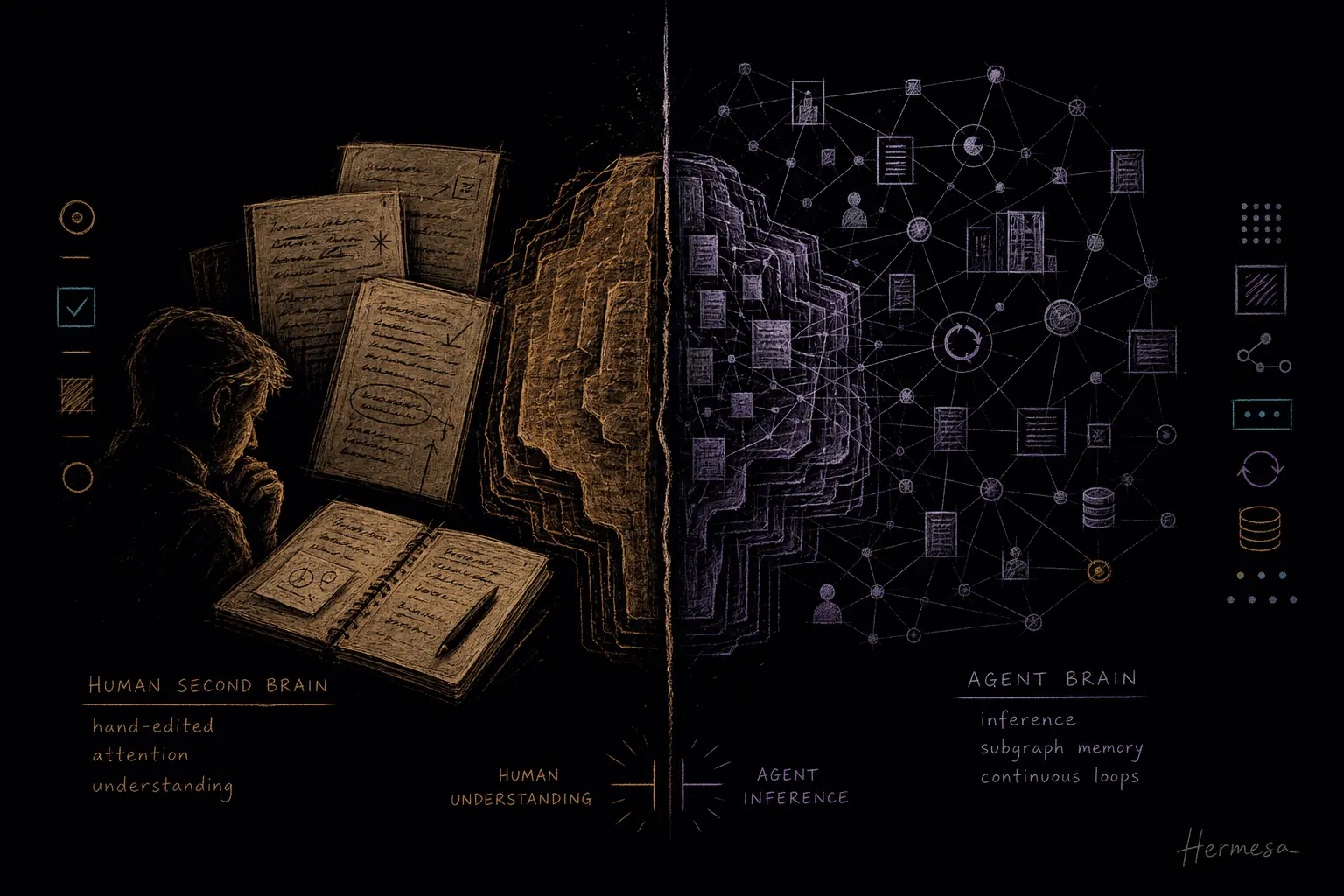
GBrain is proof that the phrase “second brain” has split into two different systems. One is a human second brain, the other is an agent brain. Both are useful. But if we use the same word for both, we mix very different things: what an AI collected, what an agent inferred, what I read, and what I actually understood.
Garry posted that his GBrain grew in a month:
- pages: 17,888 → 146,646
- people: 4,383 → 24,585
- companies: 723 → 5,339
- cron jobs: 21 → 66
My first reaction was: this cannot be a second brain. No human internalized 146k pages in a month. But the reaction was too narrow — Garry probably doesn’t mean he personally understands every page in the system.
A better reading: GBrain is a memory substrate for agents. It gives AI agents durable context about people, companies, projects, facts, timelines, relationships, and previous work — closer to an operating memory layer than a notebook. For that use case, the growth numbers are not a red flag. They are the point. An agent brain should ingest more than a human can read, connect things at a scale that would be ridiculous for manual note-taking, and remember weak signals, old conversations, and trails of evidence. Useful — but not the same thing as human understanding.
My own second brain has both layers — artefacts I curate and material an AI curates for me, GBrain-style. For example, I’m working with a leadership coach. We had a session about feedback — how to give it without crushing someone’s soul. Messy notes from me, a presentation from her, an AI pass to structure it. That’s the easy part. But Knowledge/Leadership/Feedback.md only became part of my second brain after I worked through it — arguing with parts, rewriting others, testing the whole thing against a meeting where I’d handled feedback badly. That last part is what no agent can do for me.
An agent can organize the material. Only I can internalize it.
A second brain is not just a storage system. It is a record of what passed through your attention and became part of your thinking. Quotes, notes, summaries, transcripts, screenshots, links — all useful. But the layer that does the work is the one I have actually understood; the part where the page reflects how I think, not just what I have read.
The agent layer is different. It stores material I have not read, maintains profiles of people I barely know, extracts entities from documents, surfaces connections I didn’t notice, runs cron jobs while I sleep. Powerful — but the authorship is different. And authorship is not a cosmetic detail. It changes how much trust I should put into the page.
If I open a note in my knowledge base, I need to know what kind of thing I’m reading. Is it raw source material? An AI summary? An agent-inferred connection? Something I read? Something I actually understood? These cannot all carry the same epistemic weight.
This is the part I care about — not whether Garry is “allowed” to call it a second brain. Language evolves, AI changes categories. The old Tiago Forte-style second brain was built for humans manually capturing and organizing knowledge; the new agentic version is built for AI systems that need long-term context and tools. Fine — but then we need a better taxonomy:
Source layer. Raw material. Notes, transcripts, documents, links, emails, PDFs, meeting notes, screenshots.
Agent inference layer. AI-generated summaries, entity extraction, possible relationships, candidate insights, generated dossiers.
Human understanding layer. The parts I read closely, rewrote in my own words, and integrated into how I think.
GBrain seems extremely strong as the first two layers — maybe it also supports the third. But the public discussion around “second brain” often blurs them together, and that blur is dangerous. When the system gets big enough, it starts to feel like you know more than you do.
146k pages can make your agent smarter. It does not automatically make you wiser.
If we want serious personal AI systems, we need to design for the boundary between human cognition and agent cognition. The agent should be allowed to gather, connect, summarize, and maintain context. But the system should clearly show which pages are:
- imported
- inferred
- AI-written
- human-reviewed
- human-understood
Without that, your “brain” becomes a swamp. Useful sometimes. Impressive from far away. But epistemically muddy.
The future personal AI stack probably needs both layers. I want an agent brain that collects more than I can process, and a human second brain that holds what I have actually understood. Agent brain gives leverage. My second gives understanding. The mistake is pretending they are the same thing.