Someone already did it
During my PhD, almost every research idea I had turned out to be someone else's paper. It felt like losing. It was the cheapest answer I could get, and it made search step one of anything I build.
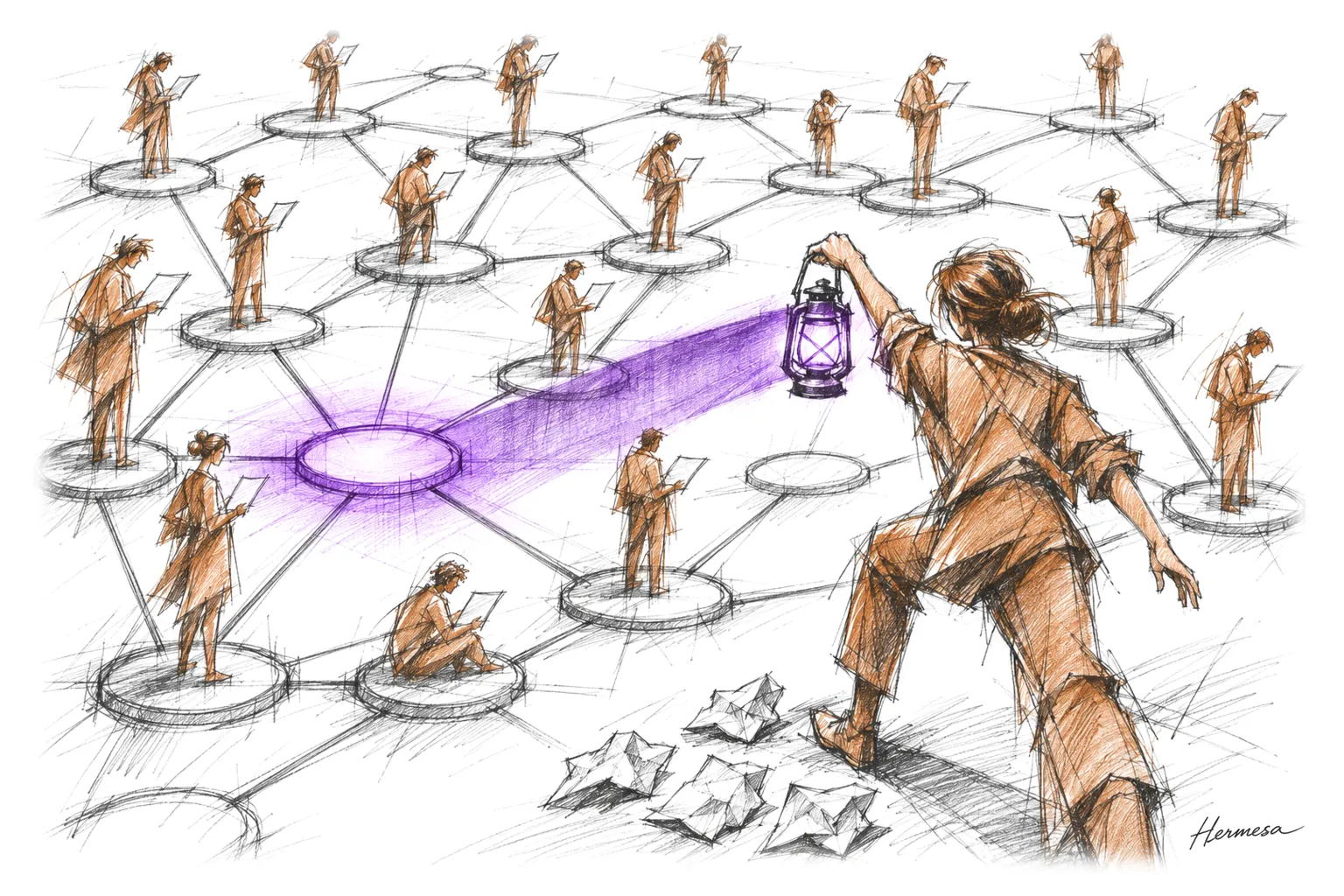
For a couple of months during my PhD, I came up with three research ideas a day. Almost every one turned out to be someone else’s paper.
A Ukrainian dissertation has to state its scientific novelty: what you found that nobody had found before. Until you can write that paragraph, you don’t have a thesis. So I went looking for mine.
I started with context. I mapped my field into a knowledge graph by hand: software architecture, the methods for improving and measuring it, and how coding agents work with it. Every day I read the AI overviews of new papers on alphaXiv (very nice, by the way), and when one hooked me, I saved it and read the full paper. I wasn’t hunting for ideas yet. I wanted to know who was working on what.
Then I wrote concepts. Each one was a one-pager: the purpose of the work, its object and its subject. I’d search for it with AI and re-read the papers, looking for the one that had already done it.
There almost always was one.
Finding an idea that looked new was a real pleasure. Finding its paper a few hours later was not. That was the rough part, three times a day.
Now I read those months differently. Every “someone already did it” cost me a few hours and saved me months. Someone else had already burned those calories for me.
The dead ideas weren’t wasted, either. Do this long enough and it starts to feel like everything has been done. It hasn’t. Each dead idea marks a spot where someone is already standing, and after enough of them the empty spot shows.
Every architecture check I found ran on code the agent had already written. My concept predicts what the agent’s plan will do to the architecture, before any code exists. It survived the search. It’s my thesis now.
The habit stayed. Step one of anything I build is a search. On a complex AI system, like the multi-tenant platform with tons of agentic features we built for a US startup, that means reading what’s already out there and building only the part nobody has. For our family budget, it meant a century of finance books first. Every system I found automated three of the four steps, so I built only the fourth.
Agents made custom software cheap, and we build it on purpose: software shaped like the team that uses it. Our retro board took less time to build than to search for. No tool I tried grouped cards by meaning, so ours does. The search is how I knew.
I ran this lesson through the same search. Someone had it decades ago: “A couple of months in the laboratory can frequently save a couple of hours in the library.” It’s usually credited to the chemist Frank Westheimer.
A paper is somebody’s year of work, left where you can find it.