Monkey See, Monkey Do
Kyiv Polytechnic offered me a course on agentic software engineering, and I've never been a beginner in the AI era. So I became one, in electronic music.
At work, I get a lot of requests to consult on what to build and how to build it. And recently I got an offer from Kyiv Polytechnic (KPI) to teach agentic software engineering.
That got me curious: how do you teach newbies to build in the AI era? I can’t answer that from experience. I learned before AI, and by the time it arrived, I had skills for it to magnify. I’ve never been a beginner in this world.
So I’m learning to produce electronic music. It’s the closest I can get to being one.
Ableton is VS Code for music producers. I stared at it the way a new engineer stares at VS Code for the first time: a lot of buttons, and none of them make sense.
I started with monkey see, monkey do. I found a producer building a track from scratch and copied every move, tinkering a little along the way. Now I understand what attack, decay, sustain and release mean, just from repeating what the master did.
After that, I took two tracks and tried to merge pieces of both into one.
And then the AI part. I connected an Ableton MCP, so I can tell Claude I want the bassline to go yayaya. It tries, and while it works I ask tons of questions about all the things I could tinker with. Claude can’t make the bassline I want, at least not from my prompts. I’ll let you know once I figure out how to ask for it, or whether it can do that at all :D
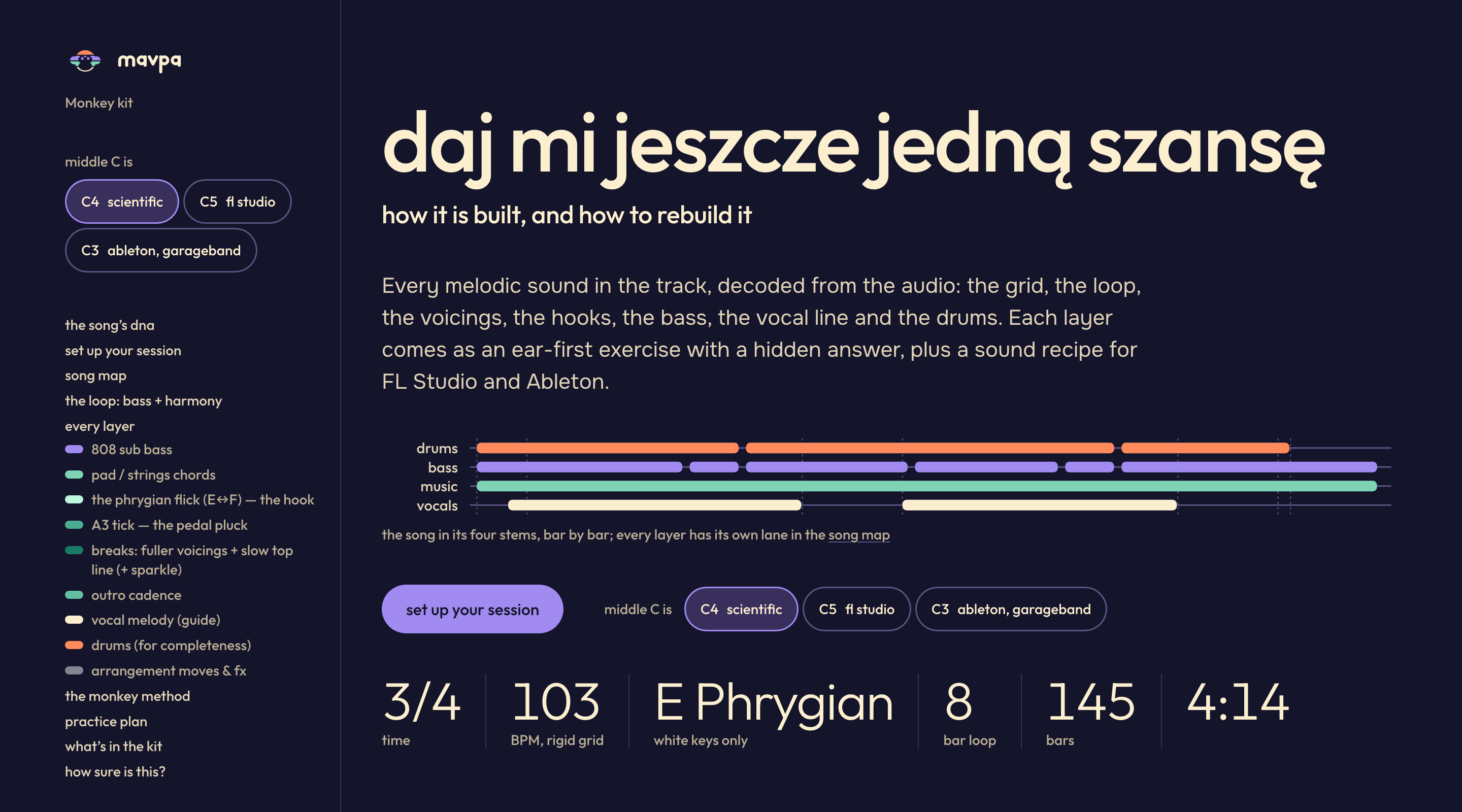
I also built an agent harness for monkeying tracks: mavpa, Ukrainian for monkey. It splits any track into stems and MIDI that rebuild into something very close to the original, so I can repeat the parts I like. It’s not perfect, but for a complete newbie it works.
By the way, you can figure out how to make a bass go yayaya or yeyeye just by saying it out loud and rendering a spectrogram of your voice. That’s how the agent works too: it can’t listen, so mavpa draws it pictures of the sound.
I think the same steps work for anything you’re curious about:
- Monkey see, monkey do.
- Learn from people who did it first.
- Explore as you go, just to see what’s possible. But not too much :D
For my students, I’m the person who did it first.
Bonus :D This is the lesson mavpa built for Daj Mi Jeszcze Jedną Szansę, the track it was born from.