A Startup From 2027
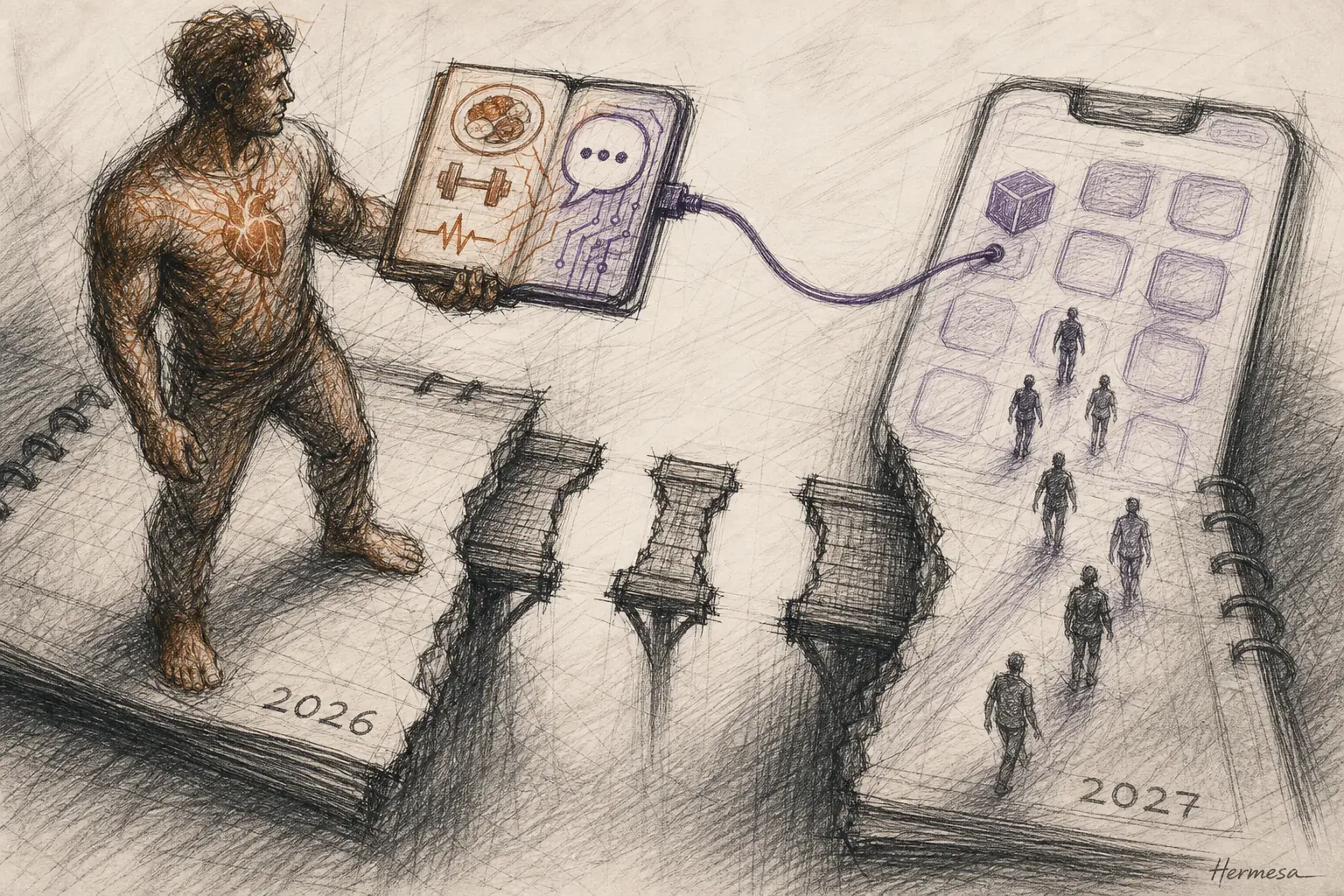
Wetware works. The market's three refusals all point to the same problem: its customers live about eighteen months from now.
Last month I gave my evenings to a slightly unserious experiment: after work I kept spinning Claude, trying to build a product from 2027–2028. The goal was never a concept deck. I wanted to imagine what software should look like once agents are where software lives, build that thing now, and see who shows up. And it wasn’t pure play: at work part of my job is steering where AI goes in the project, and nothing calibrates that judgment like trying to live in the future for a month of evenings.
The thing is Wetware: one journal of everything you eat and every way you train, kept wherever you already talk to your assistant. Technically it’s a custom connector for Claude and ChatGPT. You say “two eggs, toast and a flat white” or “bench felt heavy, 80 kg, five by five” — one sentence, in any language — and it becomes exact calories, macros and a training log. No forms, no forty taps. The chat is the app.
People showed up. Then the market told me no — three times, in three different ways.
Here’s what makes it worth writing about: the three refusals agree with each other. Each one names a condition that has to flip before this product has a real market, and all three point at the same date. I didn’t build a bad product. I built a product whose customers live about eighteen months from now.
The first refusal came at the door. I onboarded users who aren’t technical, and most of them never made it past the letters MCP. Not past the product — past the concept. What is a connector? Why does my assistant need one? Where do I even paste this URL? Adding a custom connector to Claude or ChatGPT today feels less like installing an app and more like configuring a mail server in 2003: perfectly doable, if you already know why every field exists.
The people who breeze through that setup exist, and I’m one of them. But let’s be honest about who we are. I run my own personal agent, Hermes, and I genuinely like it — which in 2026 is roughly the same personality trait as opening a conversation with “btw I use Arch.”
That’s the market: us. A rounding error with strong opinions.
No landing page fixes this. What fixes it is a better Agent OS — one where adding a capability to your assistant feels like installing an app, not passing a technical interview.
The second refusal surprised me more, because it arrived while the product was working. This is the part I’d still defend to anyone: an app whose job is to make your agent robust is the right direction. My assistant now has real telemetry on me — what I eat, how I train, plus a folder with my blood tests. I ask for a report and it cross-references all of it: protein against training volume, bloodwork against diet, tailored advice from full context. No standalone fitness app has ever known me this well.
And yet I caught myself doing something stupid. The question I ask most — how many calories do I have left today? — is recurrent, identical, daily. So I pinned the chat. The agent answers fine; pressing is just faster than asking, and Wetware has no web UI to press. I wrote about this in Where the Buttons Go: buttons survive where recurrent tasks demand a fixed place your hands already know. I just never expected to re-derive the argument inside my own product. So, a prediction: agent OSes — Claude Desktop, ChatGPT — will grow widgets and rearrangeable surfaces. Every OS ends up handing users the home screen: the iPhone shipped as a frozen grid and took thirteen years to concede widgets. Today I can’t pin a “calories left” button anywhere, and my pinned chat is a duct-tape widget.
The third refusal was about who it’s for. Wetware is precise: exact numbers, meal plans within ±5% of target, goals computed instead of guessed. Precision is what a health geek like me wants — and precision is exactly what makes a beginner’s life harder. If you’re new to training, a tool that asks you to care about macros doesn’t lower the barrier, it raises it. That’s why Cal AI won — 15 million downloads, $30 million a year, and an acquisition by MyFitnessPal, built by two teenagers — not because it’s accurate (it’s fine), but because it’s accessible. It lets you start.
Accuracy wins geeks; accessibility wins markets.
“Dumb it down” is the wrong lesson, though. Wetware’s real job is to help you build a habit. Tracking macros is the mechanism; making the journal so effortless it sticks is the job — and in health, good habits carry the maximum ROI of anything you can buy. I still haven’t decided who to build that for: Cal AI’s beginners, or the biohackers who want their blood panel in the loop. That open question is exactly what the next test is for.
Which brings me to the confession inside the confession: to be accessible in 2026, Wetware needs an app. I used to think it didn’t — that the agent makes screens optional. That was wrong in a specific, instructive way: people just like apps, and interfaces genuinely earn their keep for the everyday actions that need no agent work at all. Checking calories left is a glance, not a conversation. The scale from Where the Buttons Go applies to my own product, and right now my product occupies only one end of it.
So here’s the plan. I’ll write the rest of these learnings in public — a Wetware series, one post at a time — because the audience I need for a final PMF test reads this blog, and summer has a deadline. If you’re either kind of target, follow along.
Was building a 2027 product in 2026 a mistake? I keep the journal every day. My agent knows my body better than any app ever has. The product works.
The only bug is the year.